Personal stories
About.
From string quartet playing to leading an orchestra, and the encounters that have shaped my career.

It began with a string quartet
I was born in 1982 into a family of musicians. My father, László Mező, was the cellist of the Bartók Quartet. String quartets were part of my life from childhood, and for a long time I was certain that this was the musical path I most wanted to follow.
After the Béla Bartók Conservatory, I studied at the Liszt Ferenc Academy of Music in Budapest, graduating in 2006. By then, the Accord Quartet was already five years old: Csongor Veér, Péter Kondor, Mátyás Ölveti and I had founded it in 2001. We still play together with the same line-up.
In 2009, we won the International Johannes Brahms Competition in Pörtschach. The following year, we received Hungary’s Junior Prima Award.
Over the past twenty-five years, the Accord Quartet has performed across Europe. We have played at BOZAR in Brussels, the Museum of Fine Arts in Madrid and the Hermitage in St Petersburg, and at festivals including Menton, Sintra, Ravenna and Santander. In 2008, we also gave a concert for the Belgian royal family.
Alongside the classical repertoire, we have collaborated with contemporary composers from the outset. We prepared Iván Erőd’s three string quartets with him, for example, before recording them in Vienna.

Teachers and traditions
Between 2006 and 2009, the Accord Quartet continued its studies in Madrid and then Basel. Rainer Schmidt, violinist of the Hagen Quartet, and Walter Levin, former first violinist of the LaSalle Quartet, were central to those three years. We also studied with two members of the Amadeus Quartet and musicians from the Alban Berg, Janáček, Smetana and Bartók quartets.
We have a particularly close connection with György Ligeti’s Second String Quartet. The LaSalle Quartet gave its premiere in 1969; decades later, we were able to study it with Walter Levin, one of the musicians who first performed it.
It was in the quartet that the four of us developed our shared approach to interpretation. Much of what I learnt there would later find its way into my orchestral playing.
In 2019, I was the sole adjudicator for the Wolfe Wolfinsohn String Quartet Prize at the Royal Academy of Music in London, listening to and assessing quartets performing Brahms.

A Mozart experiment leads to the concertmaster’s chair
In 2014, Máté Hámori invited the entire Accord Quartet to join the Danubia Orchestra for a Mozart series. The experiment was to see what an orchestra might gain—or perhaps lose—when the members of an established quartet led its four string sections.
During rehearsals, it became clear that my chamber music experience could also serve me as a concertmaster. Máté then invited me to become Danubia’s concertmaster, and I have held that position ever since.
In a quartet, the four of us decide together how the music should sound. In an orchestra, a single movement or gesture has to be clear to many people at once. Being concertmaster also means paying attention to the atmosphere in rehearsals, the demands on colleagues, and knowing when to stand up for them. None of that can be separated from the music.
In 2023, I performed as guest concertmaster with the Sinfónica de Tenerife on its contemporary music programme, with Fabián Panisello and Rubens Askenar.
With Péter Eötvös
For six or seven consecutive years, we collaborated with Péter Eötvös and Gergely Vajda on the international conducting and composition courses run by the Peter Eötvös Foundation. Danubia played for the young conductors; the workshops also brought us into contact with György Kurtág and Helmut Lachenmann, among others.
Péter paid attention to how the orchestra was feeling and how well prepared it was. He knew every detail of the score and explored musical questions with us in rehearsal. He asked for our views and treated us as partners.
I also saw him conduct at the Hungarian State Opera. He used no baton, yet the smallest hand movements made tempo, dynamics and musical character perfectly clear. This is what musicians mean by a clear conducting technique.
As a concertmaster, I perhaps learnt most from the way he mentored young conductors. He showed me which gestures could help an uncertain conductor, and which might inadvertently confuse them. The conductors, in turn, learnt what signals an orchestra could respond to well. He was teaching them to conduct, but he was also teaching us how to make music with them.

With György Kurtág
Our musical collaboration with György Kurtág began through the workshops around Péter Eötvös. Before the 2018 world premiere in Milan of Fin de partie, I took part as concertmaster in the opera’s preparation, including the audio and video recordings made during that process.
On 12 October 2023, Danubia gave the Hungarian premiere at Müpa Budapest, conducted by Markus Stenz, with Kurtág in the audience. Two days later, we performed the opera in Hamburg, and subsequently in Cologne.
In a letter dated 9 November 2023, György Kurtág personally thanked Máté Hámori and me for our contribution. Of Danubia he wrote, in translation: “And they did not merely accomplish the task; they brought the work to life.”
On 19 February 2026, Kurtág’s hundredth birthday, Danubia played at Müpa once again, under Markus Stenz.

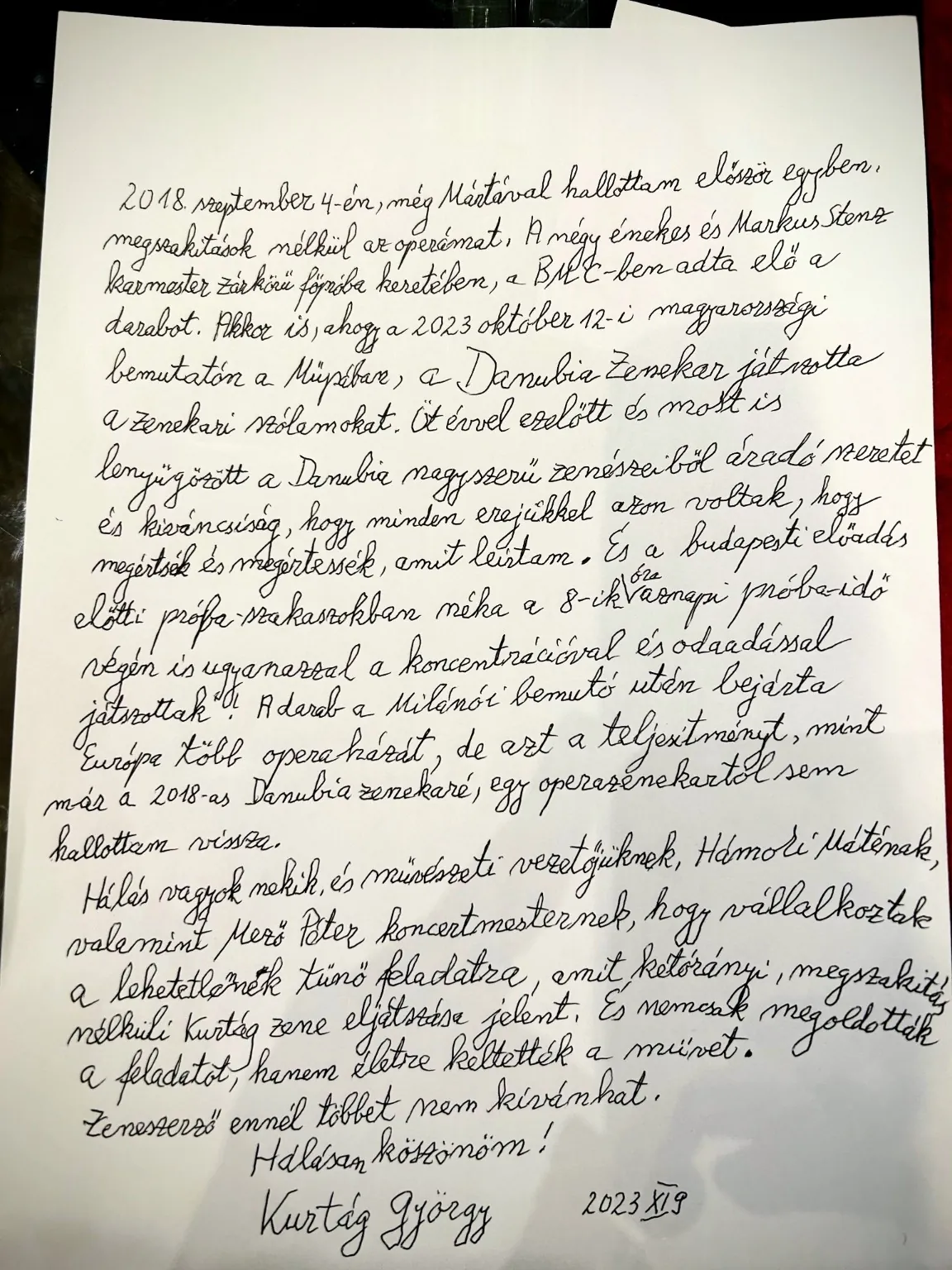
About the letter: Kurtág recalls the preparatory rehearsal in 2018 and the Hungarian premiere in 2023. He specifically thanks artistic director Máté Hámori and concertmaster Péter Mező for their contribution. View the handwritten letter (Hungarian) ↗
↑ Back to the storiesThe orchestra as a creative partner
In 2017, we performed György Ligeti’s Le Grand Macabre at the Erkel Theatre, conducted by Gergely Vajda. We also collaborated with Jeff Mills, one of the pioneers of Detroit techno, on Light from the Outside World and Planets.
I have played with Danubia in two different productions featuring John Malkovich. Report on the Blind combined Ernesto Sabato’s text with Alfred Schnittke’s music; we performed it in Budapest and Latvia. In 2022, The Music Critic turned scathing reviews of great composers into music theatre, in a production devised by Aleksey Igudesman.
Schubert–Zender’s Winterreise, directed by Kornél Mundruczó, brought a different kind of theatrical collaboration, with János Szemenyei and Máté Hámori.

Ádám Fischer, Copenhagen
In 2016, I was invited to step in with Danmarks Underholdningsorkester to record Beethoven’s Second and Fourth Symphonies under Ádám Fischer. That invitation grew into a lasting collaboration; I have been a member of the orchestra since 2019.
The complete Beethoven cycle was released by Naxos and received ICMA Recording of the Year and an Opus Klassik award in 2020. We subsequently recorded Brahms’s four symphonies, followed by Haydn’s final twenty-four.
Every recording was preceded by a concert. Making music together over so many years allows us to return repeatedly to the same composer, and to the decisions we made together before.
In March 2018, Beethoven occupied much of my time. We recorded the Sixth Symphony in Copenhagen; a few days later, the Accord Quartet played three of his string quartets in Budapest. Meanwhile, I was preparing the violin solo in the Benedictus of the Missa solemnis with Danubia.
I have also performed with Gidon Kremer in Danmarks Underholdningsorkester (the Danish Chamber Orchestra).


A path to music
From September 2012 to 2022, I taught chamber music and string quartet playing at the Liszt Academy in Budapest, and also worked with young musicians at masterclasses abroad. In 2015, I founded BachElit, where musical examples and stories from the stage opened up conversations about music, with plenty of room for the audience’s questions.
Út a zenéhez (A Path to Music), an initiative of Máté Hámori, is one of Danubia’s important programmes. Through Közös Hang (Common Sound), we play alongside children who are learning instruments through the Máltai Szimfónia programme. Small groups from the orchestra visit their communities to rehearse and give concerts; on other occasions, the children come to Budapest to perform with us. I became more actively involved later and now also serve on the board of the Út a Zenéhez Foundation. One such concert took us to Csököly in December 2025.


It was very cold in the church; even in our coats, we were freezing. A few colleagues from Danubia and I had come to play with the children. Alongside the pieces we performed together, I played the violin solo from the slow movement of Winter in Vivaldi’s The Four Seasons.
After the solo, I returned to my place behind the children, where I also played in our shared pieces. Then one little boy turned around and said to me:
“I wish I could play the violin that beautifully!”